
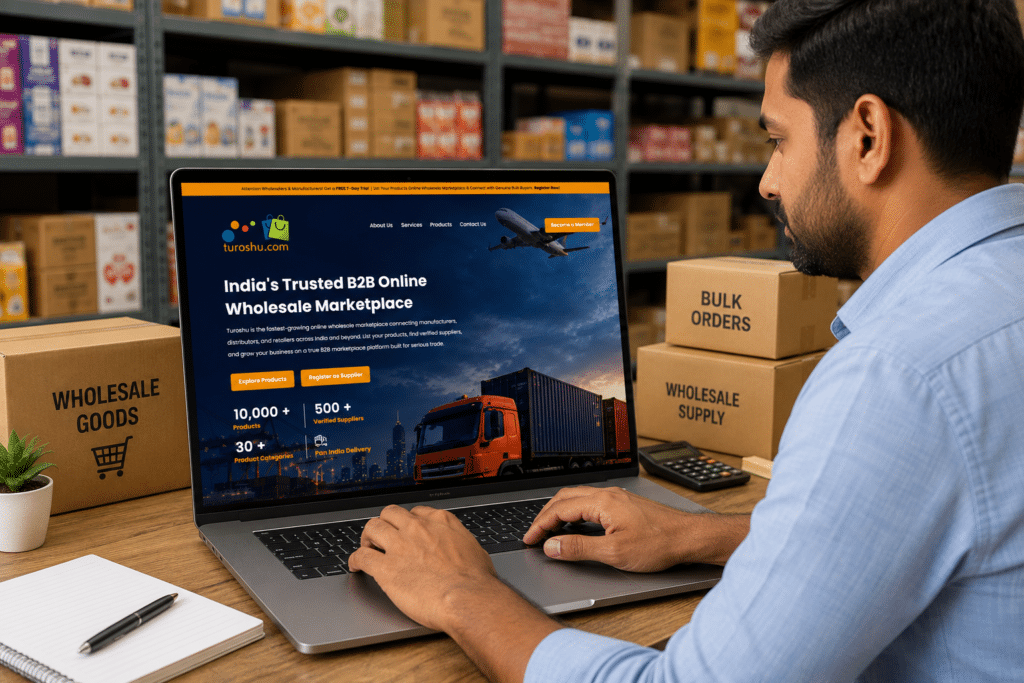
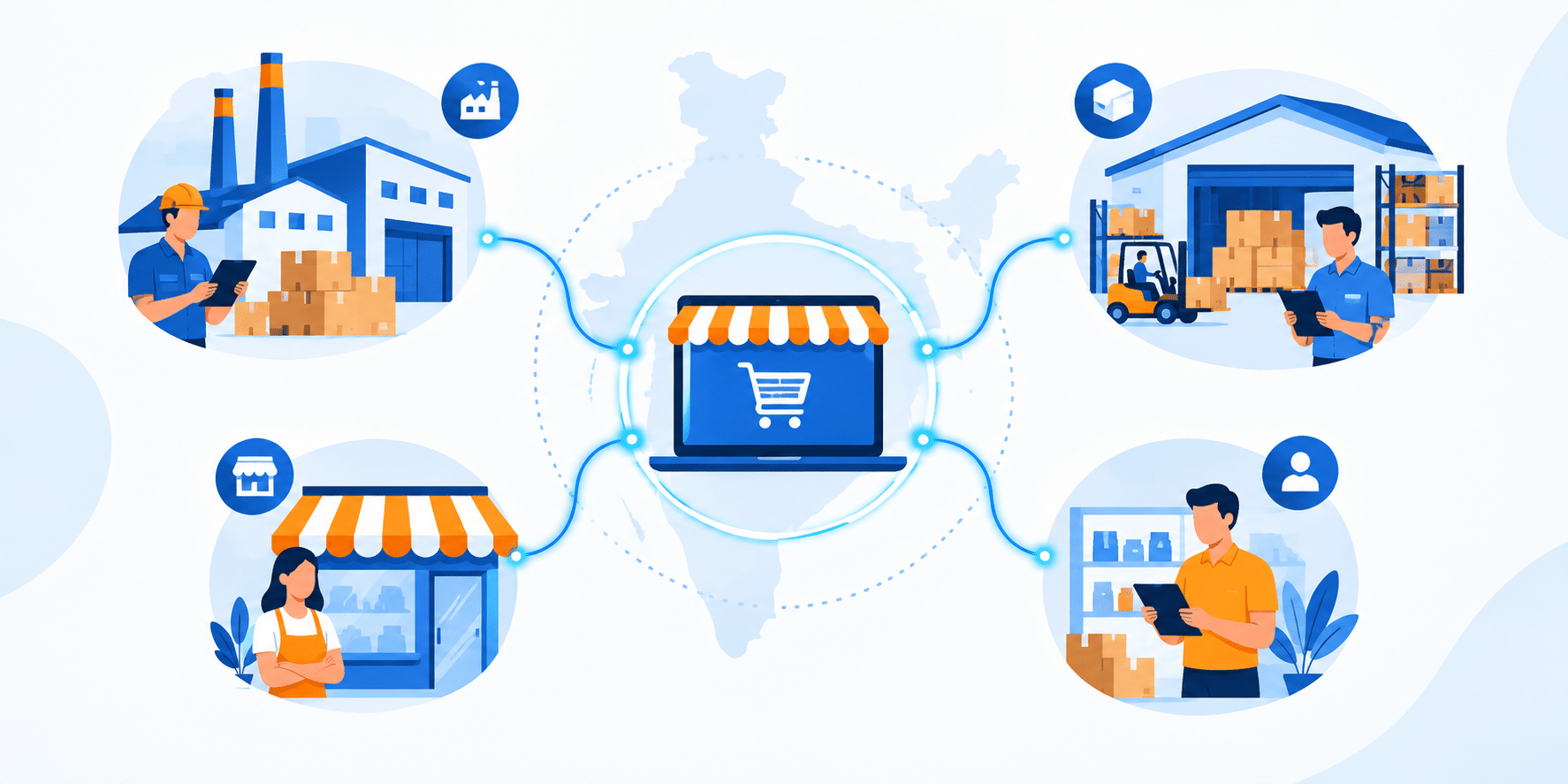
An online wholesale marketplace for retailers is a digital platform where shop owners, boutiques, and small businesses browse verified manufacturers, wholesalers, and brands, compare minimum order quantities and pricing, and place bulk orders without visiting a physical trade market. For an Indian retailer, this usually means replacing scattered supplier phone numbers and one-off trade-fair visits with a searchable catalog, transparent MOQs, and a paper trail for every order.
The shift toward digital B2B sourcing is not just convenience — it is a response to real friction retailers face: unreliable suppliers, unclear pricing, inconsistent quality, and no easy way to compare options before committing working capital. This guide walks through how online wholesale marketplaces work, how to evaluate the platforms operating in India today, and where Turoshu fits as a practical option for retailers and suppliers who want a straightforward way to connect.
An online wholesale marketplace for retailers is an internet platform that connects retail buyers directly with manufacturers, wholesalers, distributors, and brands so they can purchase products in bulk at wholesale prices instead of retail prices.
Unlike a consumer marketplace, listings are priced per unit at wholesale rates, quantities are sold in cases, cartons, or lots rather than single pieces, and buyers usually need to register a business account before prices become visible. Most platforms combine three things retailers previously had to source separately: a supplier directory, a way to compare pricing and MOQs, and a checkout or enquiry system to place the order.
A wholesaler sells goods in bulk, typically to other businesses, at a lower per-unit price, while a retailer buys those goods and sells them individually to end consumers, usually at a marked-up price to cover overheads and profit margin.
In practice, the same company can play both roles: a distributor might buy in bulk from a manufacturer (acting as a wholesale buyer) and then supply smaller quantities to shopkeepers (acting as a wholesaler to them). Online wholesale marketplaces exist to serve this middle layer — helping retailers find the wholesale side of the relationship without needing an existing industry contact.
Aspect | Wholesaler | Retailer |
Sells to | Other businesses, retailers, resellers | End consumers |
Order size | Bulk — cartons, lots, container loads | Single units or small packs |
Pricing | Lower per-unit, volume-based | Higher per-unit, includes retail margin |
Relationship | B2B (business-to-business) | B2C (business-to-consumer) |
Most online wholesale marketplaces follow a similar buying journey. Understanding each stage makes it easier to compare platforms later in this guide.
Retailers sign up with business details — shop name, GST or business registration where applicable, and contact information. Many platforms only reveal wholesale pricing after this step, since prices are meant for verified businesses, not individual consumers.
Once registered, retailers search by category, browse supplier storefronts, or send a request for quotation (RFQ) describing what they need. Filters for MOQ, price range, location, and category help narrow down options quickly.
Retailers compare minimum order quantities, per-unit pricing, and any tiered discounts for larger orders. This is also where landed cost — product price plus shipping, duties, and payment processing — starts to matter more than the sticker price alone.
Many B2B platforms are lead-based rather than instant-checkout: the retailer sends an enquiry, the supplier responds with a quote, and terms are negotiated before an order is confirmed. Others, closer to consumer e-commerce, allow direct cart-and-checkout ordering.
Depending on the platform, payment options range from advance transfers and escrow-protected payments to buy-now-pay-later terms for qualified retailers. Shipping may be arranged by the supplier, the platform, or a third-party logistics partner, and this is where actual delivery timelines and landed cost get confirmed.
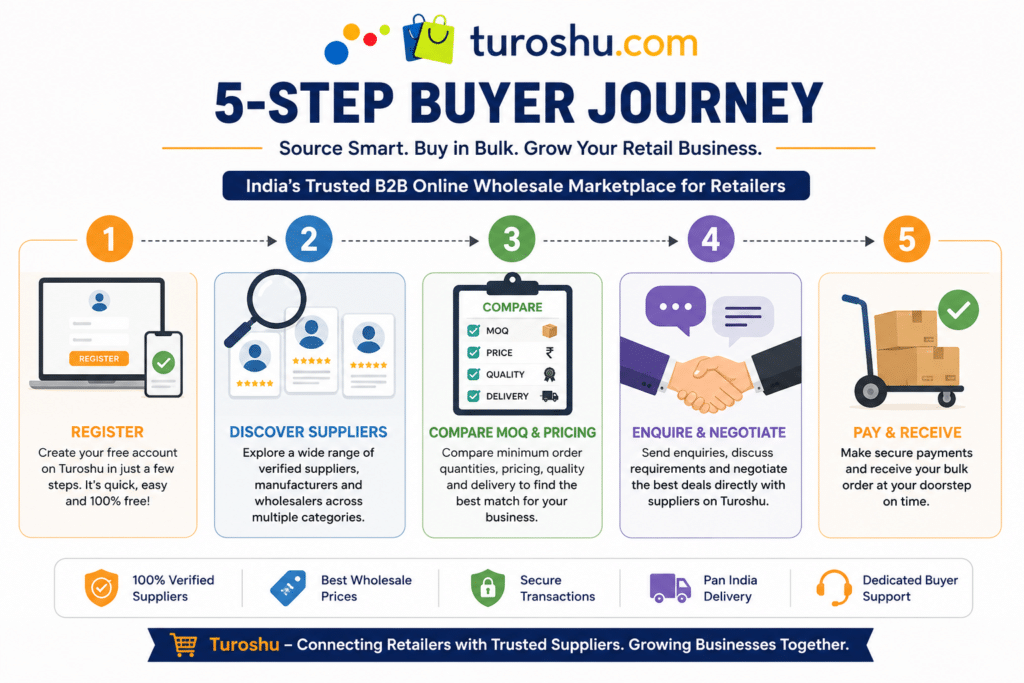
Retailers sourcing in India generally end up choosing between Indian B2B directories, global sourcing platforms, and newer wholesale-marketplace models. Here is a neutral look at the platforms most often compared, including Turoshu.
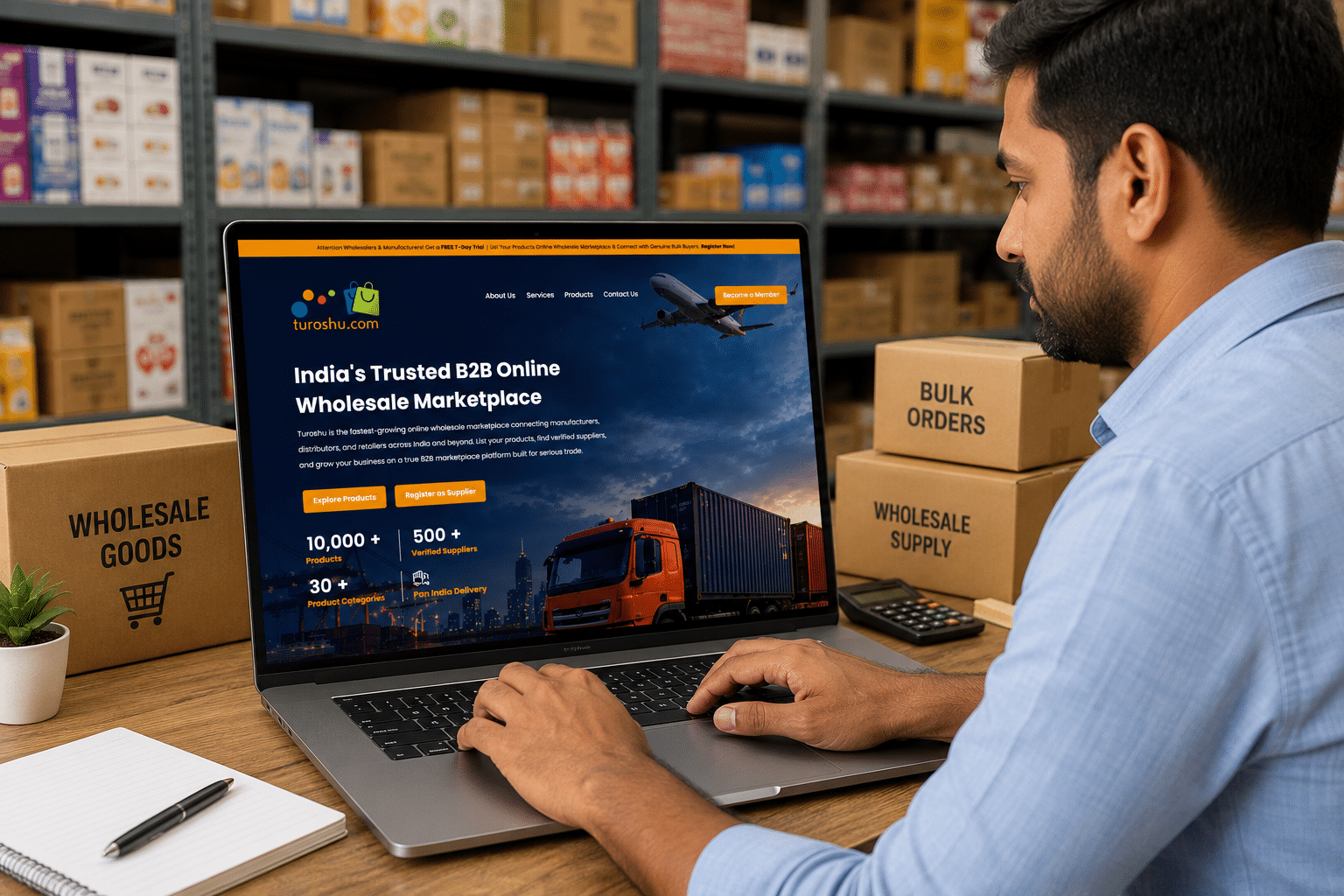
Turoshu is a B2B wholesale marketplace built to connect Indian retailers and buyers with suppliers, manufacturers, wholesalers, and brands in one place. For retailers, the value is in discovery and direct connection — searching product categories, viewing supplier and business profiles, and reaching out to place bulk enquiries without needing an existing industry contact. For suppliers, it offers a way to list products, gain visibility with retail buyers, and build ongoing buyer relationships. As with any marketplace, retailers should confirm current verification steps, fees, and payment terms directly on the platform before ordering, since these details can be updated over time.
Faire is a wholesale marketplace best known for connecting independent brands with boutique retailers across the US, Canada, UK, and parts of Europe. Retailers typically get flexible opening order minimums set by each brand, extended payment terms for qualifying buyers, and a curated catalog spanning home goods, apparel, and gifting. Commission and fees are charged to the selling brand, not the retailer, and the exact percentage has changed over time — retailers should treat any specific figure as something to verify at checkout rather than a fixed industry number.
Alibaba.com is a global sourcing platform, strongest for connecting retailers with manufacturers, mostly in China and other manufacturing hubs, for bulk and private-label orders. Minimum order quantities are set individually by each supplier rather than the platform, and buyers can often negotiate lower trial-order quantities. Its Trade Assurance service protects payments made through the platform, but it is worth knowing that this protects the transaction, not a guarantee that the supplier itself has been independently vetted — that distinction matters when comparing “verified” claims across platforms.
IndiaMART is one of India’s largest B2B platforms, structured mainly around lead generation rather than direct checkout. Retailers search or post a requirement, and verified sellers respond with quotes. It offers a free tier for basic listings and browsing, with paid seller memberships unlocking greater visibility — useful for retailers who want a wide, India-first supplier base across almost every category.
TradeIndia works on a similar lead-based model to IndiaMART, connecting manufacturers, wholesalers, and exporters with buyers across a large number of product categories. It is a solid option for retailers focused on domestic Indian sourcing and export-oriented suppliers, with free and paid membership tiers on the seller side.
Global Sources focuses on cross-border sourcing, primarily from Asian manufacturers, and is known for a more rigorous supplier verification process than open directory-style platforms. It combines its online marketplace with offline trade shows, which suits retailers who want to validate suppliers in person before committing to larger orders.
Orderchamp is a European B2B wholesale marketplace connecting independent retailers with brands, with relatively low average order minimums per brand and buy-now-pay-later terms for qualified retailers. It verifies every buyer account before wholesale pricing becomes visible. It is most relevant for retailers sourcing European brands rather than Indian suppliers.
Depending on category, Indian retailers also compare Udaan (retail FMCG and general trade), Moglix (industrial goods), Bizongo (packaging), and export-focused directories such as ExportersIndia. The right mix usually depends on product category and whether the retailer is sourcing domestically or internationally.
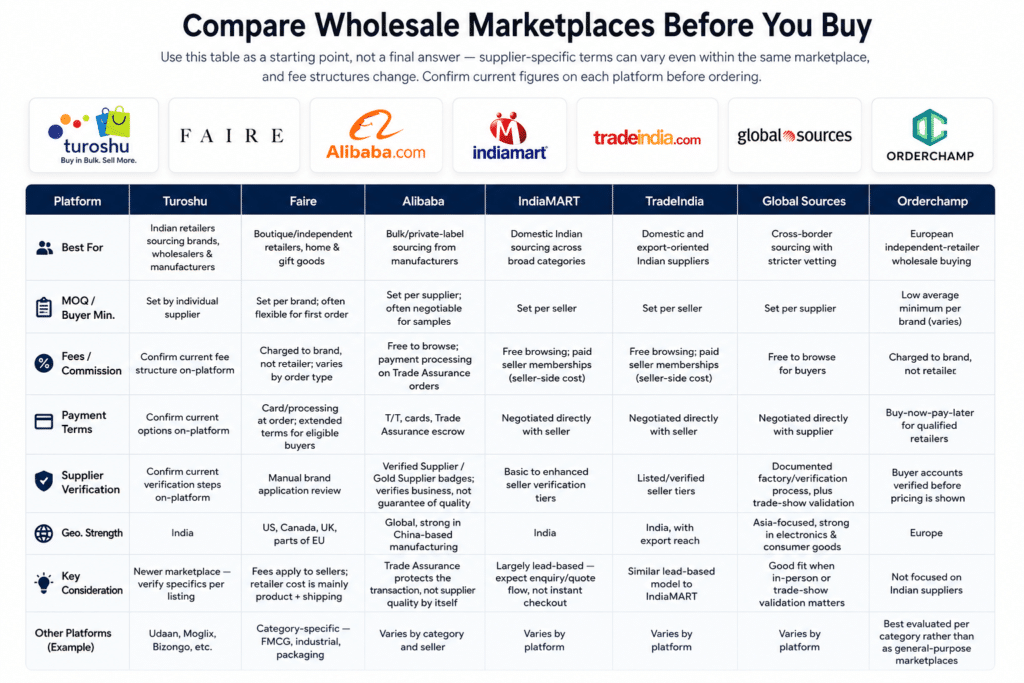
There is no single platform that guarantees the lowest MOQ across the board, because minimum order quantities are usually set by individual suppliers, not the marketplace itself. Alibaba suppliers are often willing to negotiate small trial orders or samples, Faire and Orderchamp brands frequently set flexible opening-order minimums for new retailers, and marketplaces like Turoshu, IndiaMART, and TradeIndia leave MOQ entirely to each listed supplier. The practical approach is to filter or ask for low-MOQ listings within whichever platform fits your product category, rather than assuming one marketplace is universally lower.
For boutique and independent-retail-style products — home decor, gifting, apparel, jewelry, and lifestyle goods — marketplaces built specifically around independent retailers, such as Faire and Orderchamp internationally, tend to have the deepest curated catalogs. For Indian boutique retailers sourcing domestically, Turoshu, IndiaMART, and TradeIndia offer access to Indian manufacturers and wholesalers in similar categories, which can mean shorter shipping times and simpler payment terms than importing internationally.
The right marketplace depends on what you sell, how much working capital you can commit per order, and whether you need domestic or international suppliers. Start by answering these questions:
Reliability shows up in a few concrete signals rather than marketing claims. Look for:
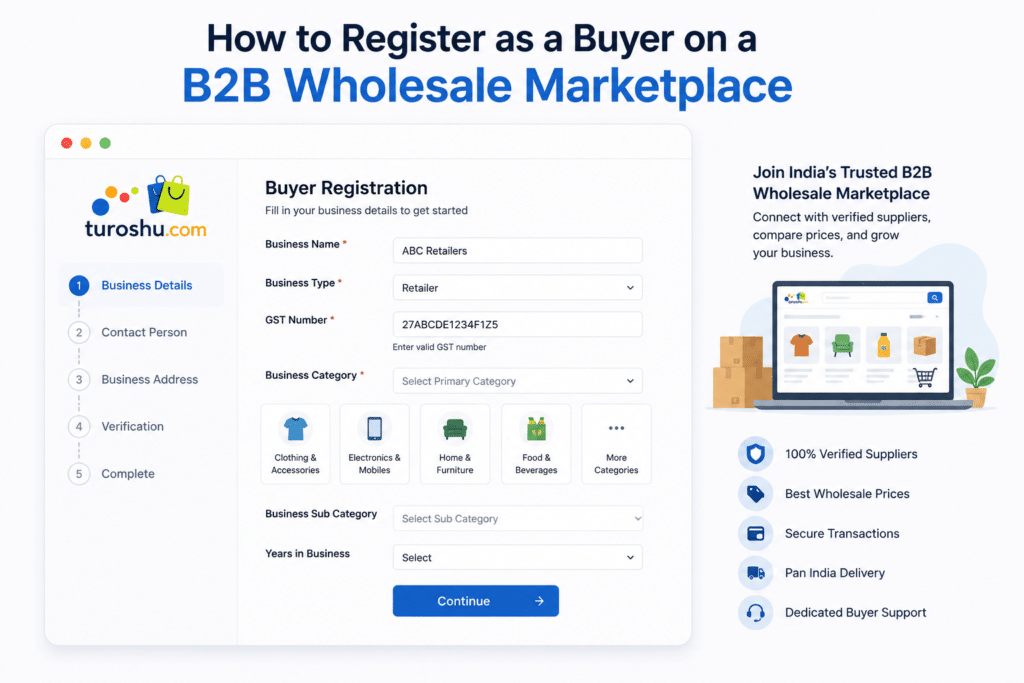
Registration steps are broadly similar across platforms, including Turoshu:
For suppliers, wholesalers, and manufacturers who want to list on a marketplace like Turoshu, the process typically looks like this:
Marketplaces generally verify suppliers using some combination of business registration checks, document review, and ongoing monitoring of buyer feedback. For the exact verification steps Turoshu currently applies — and what a “verified” badge does and doesn’t confirm — retailers should check the current details on the Turoshu platform or with the Turoshu team directly, since verification processes are refined over time and this is not a claim to generalize without confirmation.
For retailers and suppliers evaluating Turoshu, the core value proposition centers on:
As with any platform claim, retailers should treat online marketplaces for sellers -wide superlatives with caution and confirm specifics — pricing, verification depth, and current fees — directly on Turoshu before finalizing an order.
Retailers can buy wholesale products online through B2B marketplaces such as Turoshu, IndiaMART, TradeIndia, Alibaba, Faire, and Global Sources, or directly through a manufacturer’s own wholesale portal if one exists. The right starting point depends on whether you need domestic Indian suppliers or international manufacturers, and how much verification and buyer protection you need built into the process.
Buying directly from manufacturers usually means skipping intermediary distributors and negotiating pricing, MOQ, and terms one-on-one. On a marketplace, this looks like:
Wholesale marketplaces generally use one of a few fee models, and it helps to know which one you’re dealing with:
For retailers specifically, the fee that matters most is usually built into the wholesale price you’re quoted, plus separate payment processing and shipping — ask suppliers to break these out if a quote isn’t already itemized.
Use this quick-reference guide to narrow down where to start sourcing:
If you are… | Start with |
A boutique retailer sourcing Indian brands & manufacturers | Turoshu, IndiaMART, or TradeIndia |
Sourcing internationally for private label or bulk manufacturing | Alibaba or Global Sources |
An independent shop sourcing curated international brands | Faire (US/UK/EU) or Orderchamp (Europe) |
New to wholesale and want to test small trial orders first | Platforms with negotiable/low MOQ suppliers — filter within Alibaba, Turoshu, or similar directories |
A manufacturer or wholesaler looking to reach retail buyers | List on Turoshu, IndiaMART, or TradeIndia to build visibility with retailers |
It’s a digital platform where retailers browse manufacturers, wholesalers, and brands, compare pricing and MOQs, and place bulk orders directly, replacing scattered supplier contacts and trade-fair visits.
There isn’t one universal best — it depends on your product category, whether you need domestic or international suppliers, and your budget for MOQ. Compare a few platforms against your specific needs using the table above.
Through B2B marketplaces such as Turoshu, IndiaMART, TradeIndia, Alibaba, Faire, and Global Sources, or directly via a manufacturer’s own wholesale portal.
For India-focused sourcing, Turoshu, IndiaMART, and TradeIndia are commonly compared, each with different depth by category — check supplier availability in your specific niche before choosing.
By filtering for manufacturer (not trading company) listings, sending a clear RFQ with quantity and specs, requesting samples, and confirming MOQ, lead time, and payment terms in writing.
It varies by platform and is usually charged to the seller rather than the buyer — some marketplaces use flat commission percentages, others use subscription tiers or free browsing with payment-processing fees. Always confirm current rates on the platform.
Turoshu applies business verification steps for suppliers listing on the platform. For the exact current process, check Turoshu’s official verification information or confirm directly with the Turoshu team before relying on a “verified” badge for a specific order.
Yes — Global Sources is known for a more rigorous supplier verification process than open directory-style platforms, combining documentation checks with its offline trade-show validation.
MOQ is typically set by individual suppliers rather than the platform, so no single marketplace guarantees the lowest MOQ across every category — filter or negotiate for low-MOQ or trial orders within the platform that fits your product type.
Faire and Orderchamp are known for boutique-style curated catalogs internationally; for Indian boutique retailers, Turoshu, IndiaMART, and TradeIndia offer similar categories from domestic suppliers.
Many platforms, including IndiaMART and TradeIndia, offer a free basic listing tier for sellers, with paid plans for enhanced visibility. Check each platform’s current listing options, since free-tier features change.
Choosing an online wholesale marketplace for retailers comes down to matching the platform to your product category, your budget for minimum order quantities, and how much verification and buyer protection you need before committing working capital. Compare MOQ, fees, payment terms, and supplier verification side by side rather than choosing on brand recognition alone — the framework and comparison table in this guide are a practical starting point for that decision.
If you’re an Indian retailer looking to discover verified suppliers, wholesalers, and brands in one place — or a manufacturer looking to reach retail buyers — Turoshu is built for exactly that connection.
Turoshu Editorial Team
We creates practical and informative content for sellers, wholesalers, manufacturers, retailers, and businesses exploring online marketplaces and wholesale opportunities in India.
We will contact you soon.
Products
Verified Suplliers
Product Categories
Best B2B Marketplaces in India in 2026: The Complete Comparison Guide Home Blog Best B2B Marketplace In India India has an estimated 63 million MSMEs — and most of them still aren’t selling online. (Source: Kalaari Capital / DPIIT) Meanwhile, India’s B2B e-commerce market is on track to grow at nearly 17% a year through […]
Online Wholesale Marketplace for Retailers: A Complete Guide to Buying in Bulk Home Blog Online Wholesale Marketplace for Retailers An online wholesale marketplace for retailers is a digital platform where shop owners, boutiques, and small businesses browse verified manufacturers, wholesalers, and brands, compare minimum order quantities and pricing, and place bulk orders without visiting a […]
Turoshu is an online wholesale marketplace built for businesses across India. Connect with verified manufacturers and suppliers, explore wholesale products, and grow your business through trusted B2B connections.
Have a question or need support? Contact us and we’ll be happy to help.
Copyright © Turoshu. All Rights Reserved. Powered by EiBS