Most Indian wholesalers still sell the old way: phone calls, WhatsApp groups and a handful of loyal retailers. It works, until your best buyer switches supplier and the orders go quiet.
Selling wholesale online fixes that. Buyers find you, compare you and send requirements while you sleep.
The shift is already underway. Online B2B was roughly 1% of India’s B2B market in 2022, and Bessemer Venture Partners expects it to reach nearly 5% by 2030. Early sellers collect the buyers. Late sellers fight for what is left.
This guide shows you how to sell wholesale online in India, step by step: the paperwork, the pricing, the platforms and the follow-up that turns one enquiry into repeat orders.
Key Takeaways
• You need Udyam registration, a PAN, a business bank account and, for most B2B sellers, GST.
• Set a clear MOQ and price in slabs. Know your landed cost before you list.
• Start on one verified B2B marketplace. Add your own channels later.
• Reply to every RFQ fast. Clear, written quotes win bulk orders.
What does "selling wholesale online" mean?
Selling wholesale online means supplying goods in bulk to other businesses, such as retailers, distributors and resellers, through a digital channel instead of field sales and phone calls.
It differs from retail in three ways:
- Bigger orders. Buyers purchase by the carton, dozen or pallet.
- Lower unit prices. The price per piece falls as quantity rises.
- Relationship-led. Buyers ask for quotes, negotiate and then reorder.
Your online channel can be a B2B marketplace platform, your own website, or both. Most new sellers start on a marketplace because the buyer traffic is already there.
Here is how the two models compare at a glance:
| Retail selling | Wholesale selling |
Buyer | Individual consumer | Shop owner, distributor, reseller or company |
Order size | 1 to 3 pieces | Dozens, cartons or pallets |
Pricing | One price for everyone | Slabs by quantity, often negotiable |
Sales cycle | Minutes | Hours to weeks (quote, sample, order) |
Repeat business | Occasional | The main source of profit |
If you already supply shops by phone, you are doing wholesale. Going online simply puts your catalogue, prices and trust signals where more buyers can see them, around the clock and across states.
Why sell wholesale online in India now?
Four numbers explain the opportunity:
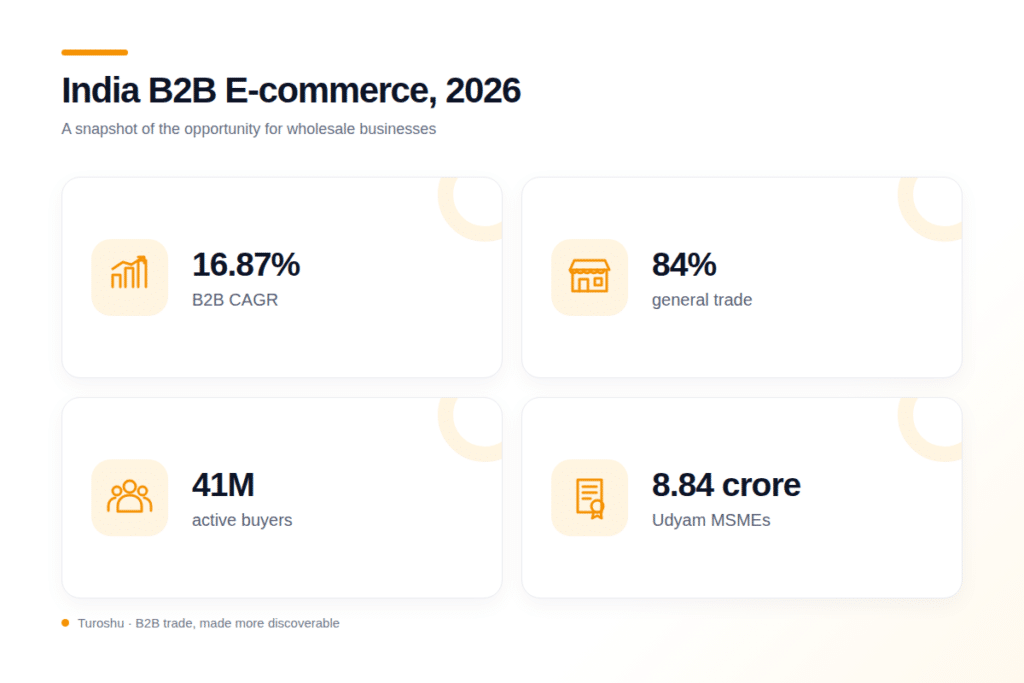
- Fast growth. Mordor Intelligence expects the B2B slice of India’s e-commerce market to grow at a 16.87% CAGR from 2026 to 2031, ahead of consumer e-commerce.
- Huge offline base. Redseer says general trade holds 84% share in India, the largest among developed markets, and projects B2B e-commerce GMV of $90 to $100 billion by 2030.
- Buyers are already online. IndiaMART reported 41 million active buyers and 8.8 million supplier storefronts in the June 2026 quarter.
- More formal sellers. The MSME ministry told Parliament that over 8.84 crore enterprises had registered on Udyam platforms by 30 June 2026.
One warning sign is worth noting. IndiaMART’s paying suppliers stood at 218,000, and the company lost about 1,850 paying suppliers in the quarter, mostly from its entry-level plan. Many sellers pay for visibility and do not get enough value back. Judge any Indian B2B marketplace on lead quality, not on how loud it is.
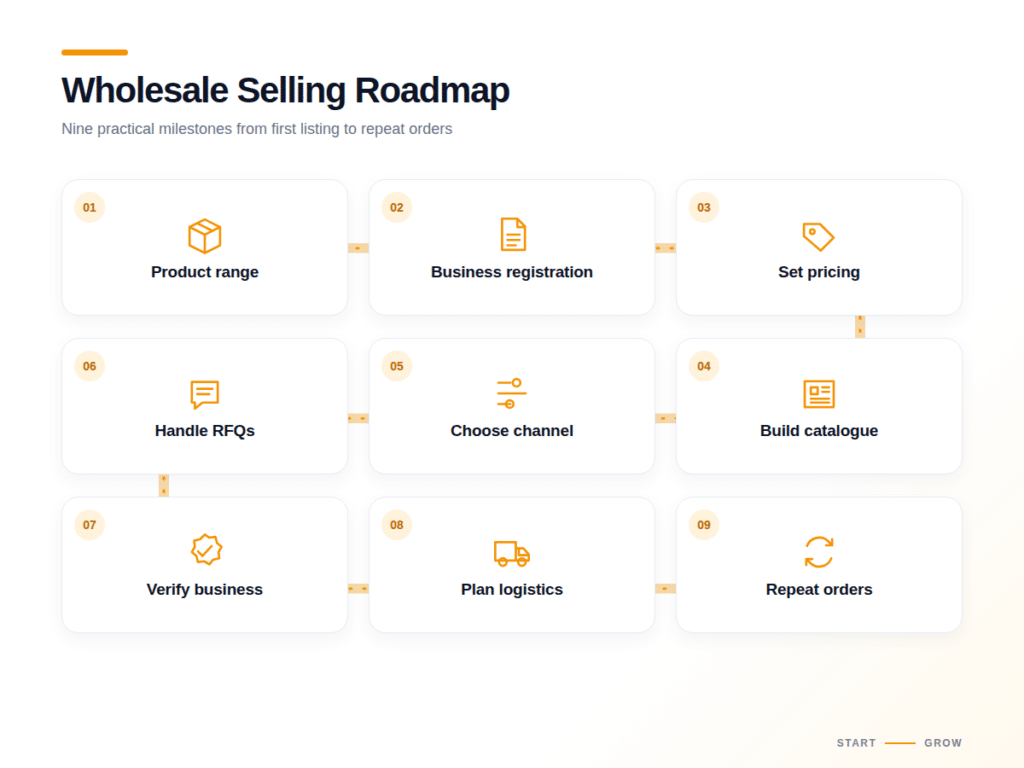
How to sell wholesale online in India: 9 steps
Step 1: Pick products with proven bulk demand
Start where demand already exists. Good wholesale products are:
- Bought again and again (consumables, apparel basics, packaging).
- Easy to store and ship.
- Profitable at volume.
- Consistent in quality, batch after batch.
Check demand before you stock. Browse live categories and read what buyers ask for. Turoshu lists 30+ categories, from agriculture and apparel to machinery and packaging, so you can see where requirements cluster. Selling garments? Start with our guide to clothing wholesale suppliers in India.
Use this quick filter on every product you are considering:
- Demand: do buyers search for it or post requirements for it?
- Margin: do you still earn a profit at your lowest price slab?
- Supply: can you deliver the same quality for the next 12 months?
- Logistics: is it light, sturdy and cheap to move across states?
Products that pass all four tests, such as apparel basics, packaging material, hardware, personal-care items and food staples, make strong wholesale lines. Products that are fragile, seasonal or hard to standardise need more care.
Pick one hero category first. A focused catalogue is easier to price, photograph and fulfil.
Step 2: Sort your registrations
Buyers trust sellers who look legitimate. Get these in place first:
- Udyam Registration. Free on the official Udyam portal. It unlocks MSME credit schemes and payment protection (more in Step 8).
- PAN and a current account in your business name.
- GST registration. Most business buyers want a GST invoice to claim input tax credit, so GST makes you easier to buy from. For goods, registration is mandatory above ₹40 lakh turnover (₹20 lakh in special-category states), and some interstate supplies have their own rules. Check the GST portal or ask a chartered accountant.
- Product licences where relevant, such as FSSAI for food or BIS for certain goods.
Good news for traders: wholesale and retail trade businesses can register as MSMEs, so you do not need to be a manufacturer to claim Udyam benefits. The benefits include easier access to institutional credit, and the 2026-27 Union Budget announced further steps to ease credit for registered MSMEs.
Registration is a one-time job that takes most sellers a few days. Do it before you list, because platforms ask for these documents during verification and buyers often ask for them before the first order.
Step 3: Price in slabs and set your MOQ
Wholesale pricing starts with your landed cost: product cost, packing, freight, platform or lead cost and your time. Add your margin on top, then build quantity slabs.
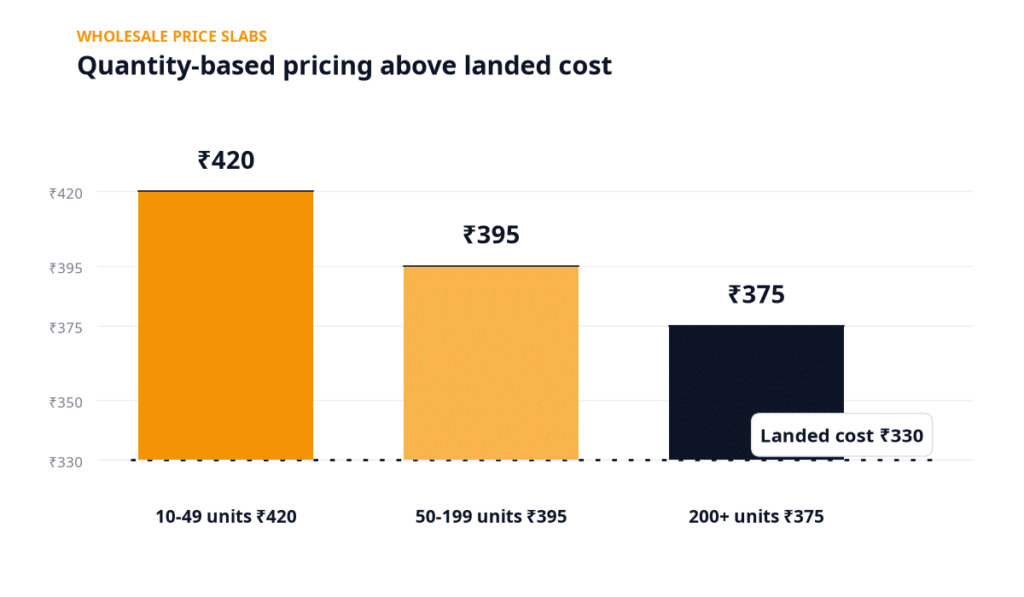
Here is an illustrative example (not a price recommendation). Assume a landed cost of ₹330 per unit:
Order quantity | Price per unit | Profit per unit | Gross margin |
10 to 49 units | ₹420 | ₹90 | 21.4% |
50 to 199 units | ₹395 | ₹65 | 16.5% |
200+ units | ₹375 | ₹45 | 12.0% |
The maths is simple: gross margin = (price – landed cost) / price. At ₹395 against a ₹330 landed cost, you keep ₹65 on every unit, a 16.5% margin.
Two rules keep you safe. Never let your biggest slab fall below break-even plus a buffer. And set a minimum order value so small orders do not eat your handling costs.
Why slabs? They reward bigger orders, which lowers your cost per shipment, and they give buyers a reason to add one more carton. Why a clear MOQ? It filters out casual browsers and tells serious buyers you run a real wholesale operation. Many sellers also offer a small sample pack at a fixed price so new buyers can check quality before a large order.
Step 4: Build a catalogue buyers can trust
Buyers cannot touch your product. Your listing is the sample. Include:
- 3 to 5 clear photos on a clean background, plus one for scale.
- Specifications: material, size, pack size, colour options and HSN code.
- MOQ, price slabs and lead time.
- Certificates or test reports, if you have them.
Write titles the way buyers search. A simple formula is product + material + size or type + pack size + MOQ. For example, “Cotton Round-Neck T-Shirt, 180 GSM, Pack of 12, MOQ 5 Packs” beats “Best Quality T-Shirt” every time, because it answers the buyer’s first questions in one line.
A complete listing on an online selling platform gets more serious enquiries because buyers can qualify you before they call.
Step 5: Choose where to sell
You have four main routes. Most sellers combine two.
Channel | Best for | Cost | Watch out for |
B2B marketplace | Fast access to business buyers | Free to subscription, depending on platform | Lead quality and crowded categories |
Your own website | Brand control and repeat buyers | Domain, hosting, marketing | Slow traffic in the first year |
WhatsApp and social | Existing customers | Free | Hard to scale, no verification |
Offline agents and trade fairs | Local relationships | Travel and commissions | High cost per order |
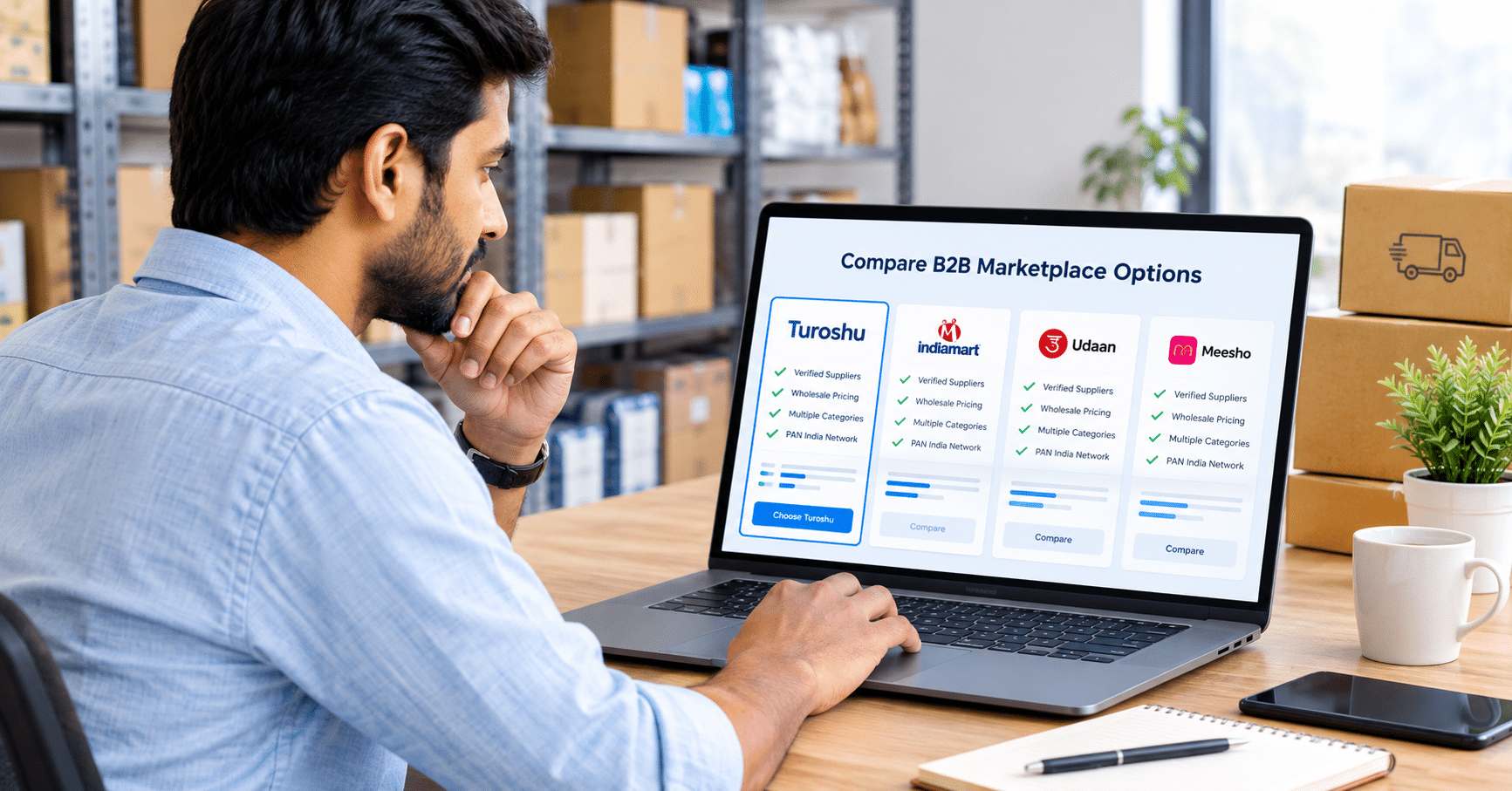
For most new online sellers, one verified online marketplace for sellers is the fastest start. Compare options in our guides to IndiaMART and TradeIndia alternatives and the best B2B marketplaces in India, or see why some businesses call Turoshu the best B2B portal in India.
A transparent note: Turoshu launched in 2026 and lists 500+ verified suppliers and 10,000+ products, which is smaller than long-established players. That is why it offers a free 7-day trial. Test it, check the lead quality yourself and decide.
Step 6: Register and get verified
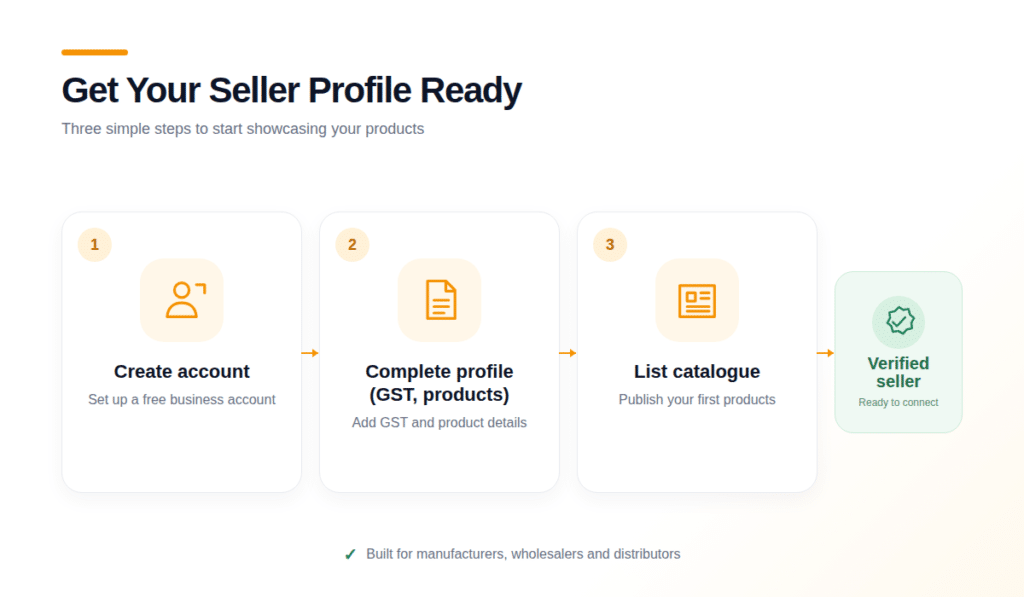
Registration on Turoshu takes three steps:
- Create a free business account.
- Complete your company profile with GST and product details.
- List your first catalogue.
Keep these ready: business registration certificate, GST certificate (if applicable), PAN, address proof and bank details. Verification earns you a trust badge, which helps buyers feel safe contacting you.
Step 7: Answer RFQs like a pro
An RFQ (request for quotation) is a buyer asking for your price on a specific quantity. It is the clearest buying signal you will get. Reply fast, in writing, with everything the buyer needs:
- Price per unit for their quantity.
- MOQ and lead time.
- Payment terms.
- Quote validity (for example, 7 days).
Then ask one question: the delivery pincode. It lets you quote freight accurately and shows you are serious. A central RFQ dashboard keeps every request in one place so none slips through.
Step 8: Plan payments, dispatch and compliance
- Payment terms: advance, 50-50 or short credit. Use bank transfer or UPI and keep every invoice GST-compliant.
- E-way bill: generally needed when the goods value in a consignment exceeds ₹50,000. Check exemptions on the E-Way Bill portal.
- Late payments: under the MSMED Act, buyers must pay registered micro and small suppliers within 45 days. The MSME Samadhaan portal handles delayed-payment claims, and nearly 27,000 cases have been registered under the online dispute resolution scheme.
This is where your Udyam certificate from Step 2 pays for itself.
Freight terms: decide upfront who pays for transport. “Ex-works” means the buyer arranges and pays for pickup. “Delivered” means you quote the price including freight. Ex-works is simpler for new sellers, while delivered pricing often wins more orders from buyers in other states. Whichever you choose, write it on the quote.
Check your buyer too. Genuine buyers welcome questions. Ask for the business name and GST number, and verify the GST number on the GST portal before you dispatch a large order. For a first order from a new buyer, ask for full or partial advance, then offer credit once trust is built.
Step 9: Turn first orders into repeat orders
The first order costs you effort. The fifth costs almost nothing. To get there:
- Confirm dispatch and share tracking the same day.
- Follow up after delivery and ask for feedback.
- Keep stock and prices updated so buyers never see stale data.
- Track enquiries, response time and conversion in your dashboard.
Also keep your profile fresh. Add new products every month, update prices when your costs change and refresh photos for your best sellers. Active profiles look reliable, and platforms tend to show complete, recently updated listings to more buyers.
If you also supply shops, point them to our online wholesale marketplace for retailers so they can reorder from you directly.
5 mistakes that cost wholesale sellers orders
- No MOQ or slabs. Buyers cannot tell if you are really wholesale.
- Weak photos. Dark, single-angle images kill trust.
- Slow replies. The first quote often wins.
- Skipping GST basics. Many business buyers need a tax invoice.
- Spreading too thin. Five half-managed platforms lose to one well-run profile.
Your wholesale launch checklist
- Udyam, PAN, bank account and GST sorted.
- Hero category chosen.
- Landed cost, MOQ and price slabs written down.
- 5 to 10 products listed with full specs and photos.
- RFQ reply template saved.
- Payment terms and dispatch process agreed.
FREQUENTLY ASKED QUESTIONS
Start selling wholesale online today
Selling wholesale online is a sequence, not a secret: get your registrations right, price in slabs, list a trustworthy catalogue, answer RFQs fast and look after repeat buyers. Do those five things well and the rest follows.
Not sure where to begin? Here is a simple plan for this week:
- Day 1: apply for Udyam and gather your PAN, GST and bank details.
- Day 2: choose your hero category and calculate landed cost for five products.
- Day 3: write MOQ and price slabs, then photograph those five products.
- Day 4: create your seller account and list the catalogue.
- Day 5: save your RFQ reply template and set a daily time to answer enquiries.
Ready to try it? List your products free for 7 days on Turoshu, an online wholesale marketplace built for Indian manufacturers, wholesalers and suppliers. Want more guides first? Browse the Turoshu blog.