Renewing a B2B directory plan is a strange kind of gamble. You pay upfront. Enquiries arrive. Then you find out how many were real.
If that sounds familiar, you are in good company. Sellers keep searching for IndiaMART alternatives, and the platform’s own latest numbers show why the conversation is getting louder.
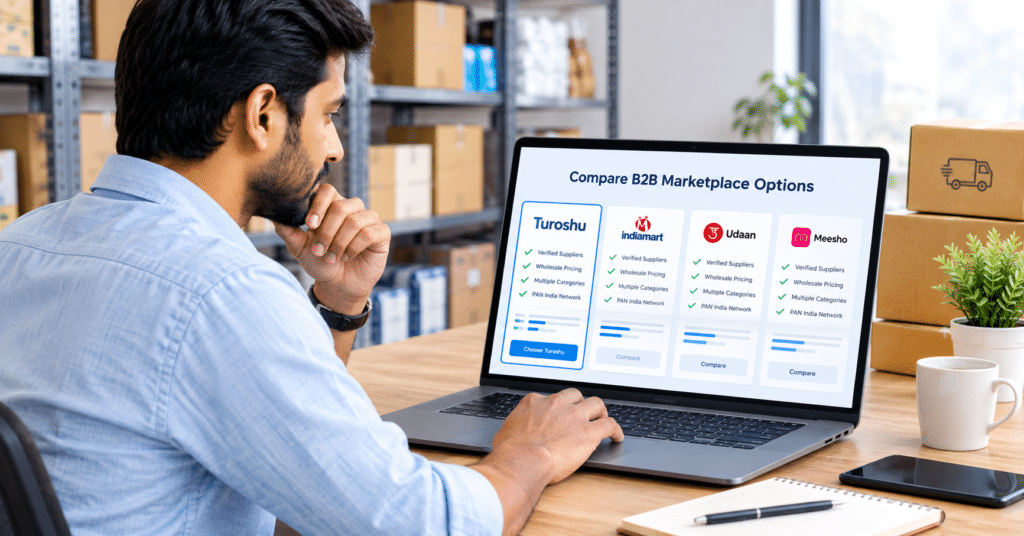
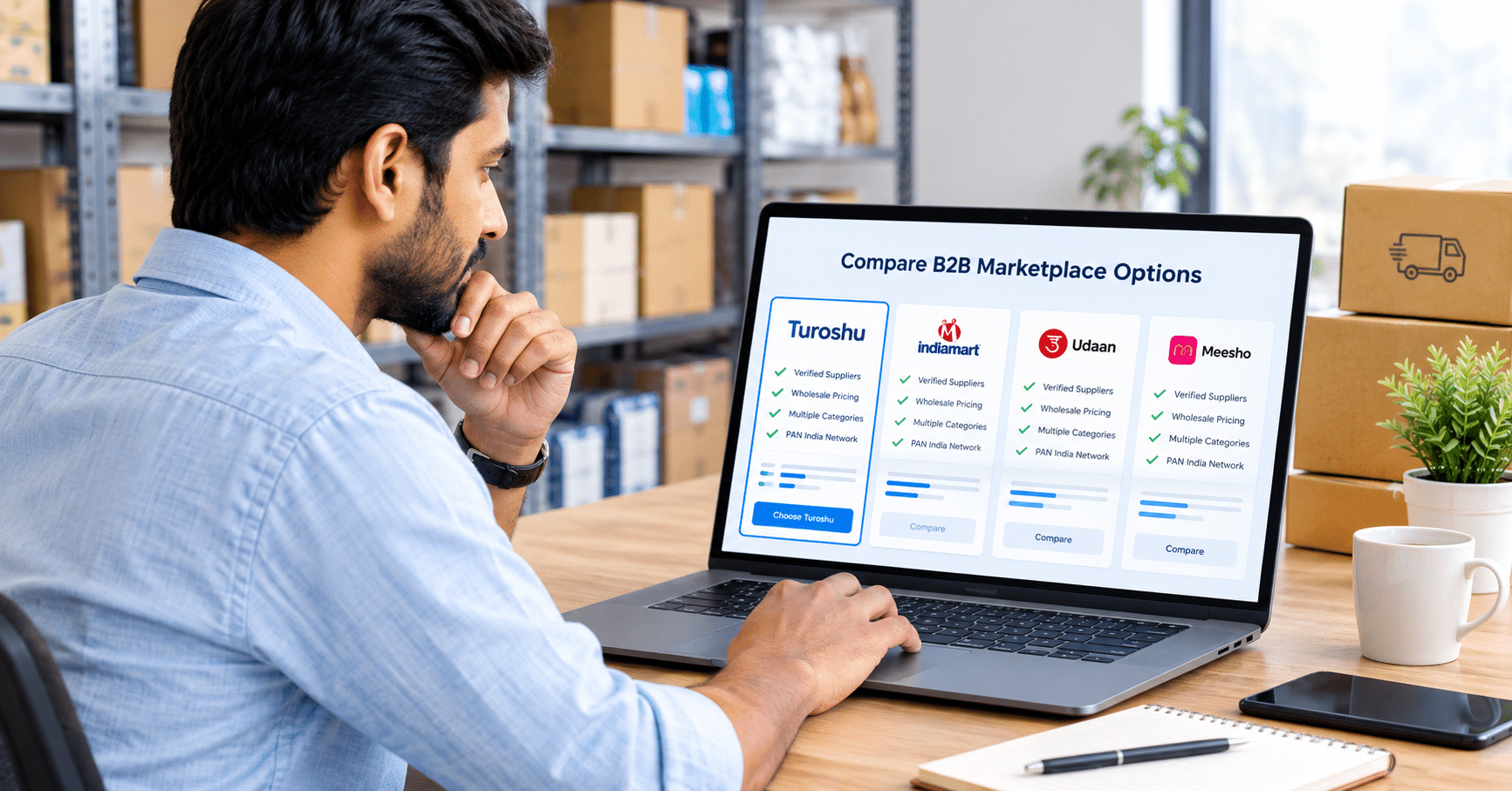
This guide compares the main options honestly: what each is good at, where each falls short, and how to test one before you commit real money.
Disclosure: this article is published by Turoshu, a wholesale marketplace. We are one of the options below, so we held ourselves to one rule: every number has a source, and nothing goes in that we cannot back up.
The short answer
There is no single best alternative. Pick by business model:
- Want directory reach? TradeIndia is the closest like-for-like directory.
- Selling fast-moving goods to small shops? Udaan runs a transaction-first model built for retailers.
- Exporting? ExportersIndia and Alibaba.com offer wider global reach.
- Want a newer, verification-led marketplace with no setup fee (per its site)? Turoshu is built for that. It launched in 2026, so judge it by a small trial, not by scale.
Why sellers are looking beyond IndiaMART
IndiaMART is still the giant. Let’s be fair about that first. In the quarter ended 30 June 2026 (Q1 FY27), it reported:
- 26 million unique business enquiries in the quarter
- 8 million supplier storefronts, up 5% year on year
- 218,000 paying suppliers at quarter end
- ₹414 crore consolidated revenue, up about 11% year on year
Now read between the lines. Those figures carry four signals worth knowing.
1. The paying base shrank
Paying suppliers fell by about 1,850 in the quarter. Management pointed to fewer new sign-ups and higher churn in the entry-level Silver tier. When the cheapest plan churns fastest, small sellers are voting with their wallets.
2. Enquiries slipped
One analyst summary of the earnings deck reported enquiries down 11% year on year. On the call, management described buyer activity as broadly flat, citing tighter OTP verification and a possible shift of search traffic toward AI assistants. Either way, volume is not growing the way it once did.
3. Revenue is concentrated at the top
The top 10% of paying suppliers, roughly 22,000 accounts, generate about 51% of revenue. Platinum and Gold subscribers are half of customers and over 75% of revenue. Bigger spenders sit at the front of the queue.
4. Most storefronts do not pay
Divide 218,000 paying suppliers by 8.8 million storefronts and you get roughly 2.5%. (That is our calculation from the reported figures.) In crowded categories, you compete with a lot of listings for the same buyer’s attention.
To be fair, IndiaMART is responding. It has talked about stronger buyer and seller verification, a buyer payment protection programme, and AI-based matching. The direction is right. Whether it fixes your specific category is something only a test can tell you.
Six questions to ask before paying any B2B marketplace
Forget brand names for a minute. Any platform, including ours, should pass these tests:
- Buyer verification. Does it check that buyers are real businesses, not just phone numbers?
- Seller verification. Does it check GSTIN, Udyam registration, or similar documents?
- Cost per genuine enquiry. Divide what you pay by the enquiries that got a genuine reply. More below.
- Payment safety. Is there escrow, trade assurance, or a payment protection scheme?
- Data ownership. Can you export your catalogue and enquiry history?
- Exit terms. What happens to your leads and ranking if you stop paying?
How to calculate cost per genuine enquiry
This is the metric most sellers never track. The formula is simple:
Cost per genuine enquiry = total plan cost ÷ enquiries that led to a real conversation
Illustrative example, not a real result: you pay ₹60,000 for a year and receive 300 enquiries. Only 30 are real buyers who reply. That is ₹2,000 per genuine enquiry, not ₹200. Run this number for every platform and the ranking often changes.
The alternatives, compared
1. Turoshu
Model: online wholesale marketplace founded in 2026 by Tushar Goel, connecting manufacturers, wholesalers, distributors, suppliers and retailers. Its site lists verified seller badges, trade assurance with secure payments, a central dashboard for buyer requests, account managers to help with listings, and flexible plans with no setup fees.
Best for: sellers who want to test a verification-led marketplace without a large upfront commitment.
Watch out: it is new. Its buyer base is smaller than the incumbents’, so start with a focused catalogue and measure results the way this article suggests.
2. TradeIndia
Model: B2B directory.
Best for: sellers who want reach similar to IndiaMART from another long-established name.
Watch out: it works on the same directory logic. One industry roundup notes that in crowded segments, hundreds of suppliers compete for the same buyers and premium placement is expensive. Expect the same need to measure lead quality.
Both platforms date to 1996, according to an industry roundup by Exporters Worlds, so neither is the new kid.
Practical tip: if you already have a well-optimised IndiaMART profile, do not rebuild from scratch. Copy your photos, specifications and price bands into a TradeIndia listing and compare the first 30 days. Small differences in category placement and response speed often explain more than the platform itself.
3. Udaan
Model: transaction-first wholesale marketplace, launched in 2016. Buyers order on the platform instead of sending an enquiry, and the transaction runs through Udaan.
Best for: FMCG, lifestyle and consumer goods sold to kirana stores and small retailers, especially in tier-2 and tier-3 cities. Reports also mention built-in logistics and working-capital credit for buyers.
Watch out: it is a poor fit for custom, specification-led or industrial products, where you need to talk to the buyer before quoting.
A useful way to think about Udaan: it removes the lead-chasing step. You list, buyers order, you fulfil. That works when your product is standard and your margin can absorb platform terms. It works less well when every order needs a conversation.
4. ExportersIndia and Alibaba.com
Model: export-oriented marketplaces.
Best for: sellers who ship abroad and want access to international buyers.
Watch out: global competition is stiffer, documentation matters more, and these platforms are not designed for small domestic lots.
Before you go global, get your paperwork in order: Import Export Code, GST registration, clear product specifications, and packaging photos that meet overseas buyers’ expectations. Export platforms reward complete profiles.
5. Your own channels
This one is not an either-or. A WhatsApp Business catalogue, your own website and trade shows keep repeat buyers close and cost nothing per lead. Use marketplaces for discovery, and move good buyers to your own channel.
Which one fits your business?
If you are… | Start with… |
A manufacturer with custom or spec-led products | A directory or verification-led marketplace where buyers send enquiries, plus your own site |
A distributor of branded fast-moving goods | A transaction marketplace such as Udaan, plus a directory for reach |
An exporter | An export-focused platform, with Udyam and export documents ready |
A small wholesaler testing the waters | Two platforms in parallel, 30 days, tracked with the same sheet |
A retailer looking for suppliers | A verification-led marketplace; check GSTIN and ask for samples first |
A 30-day test plan you can copy
- Days 1 to 3: set up. Choose 10 to 20 products that represent your range. Use identical photos, prices and descriptions on every platform.
- Days 4 to 7: track. Log every enquiry in one sheet: source, buyer name, company, GSTIN, product, quantity, reply status.
- Days 8 to 21: respond fast. Reply within an hour during business hours. Slow replies will skew your test, not the platform.
- Days 8 to 21: verify. Verify each serious buyer on the GST portal, and ask for a company email and registered address.
- Day 28: score. Count genuine enquiries, samples sent, and orders. Work out cost per genuine enquiry.
- Day 30: decide. Keep the best one or two. Cancel the rest before the renewal date.
How B2B marketplaces make money (and why it matters to you)
The business model decides whose interests come first. Three models cover most of the market.
Subscription directories
You pay a fixed fee for visibility and access to enquiries. IndiaMART is subscription-led, with tiers that run from Silver up to Platinum. The platform earns whether or not you win an order, so your job is to prove the return yourself.
Transaction marketplaces
The platform takes a share when an order completes. Udaan follows this pattern. Your incentives line up better with the platform’s, but you give up some control over pricing and the buyer relationship.
Hybrid and verification-led models
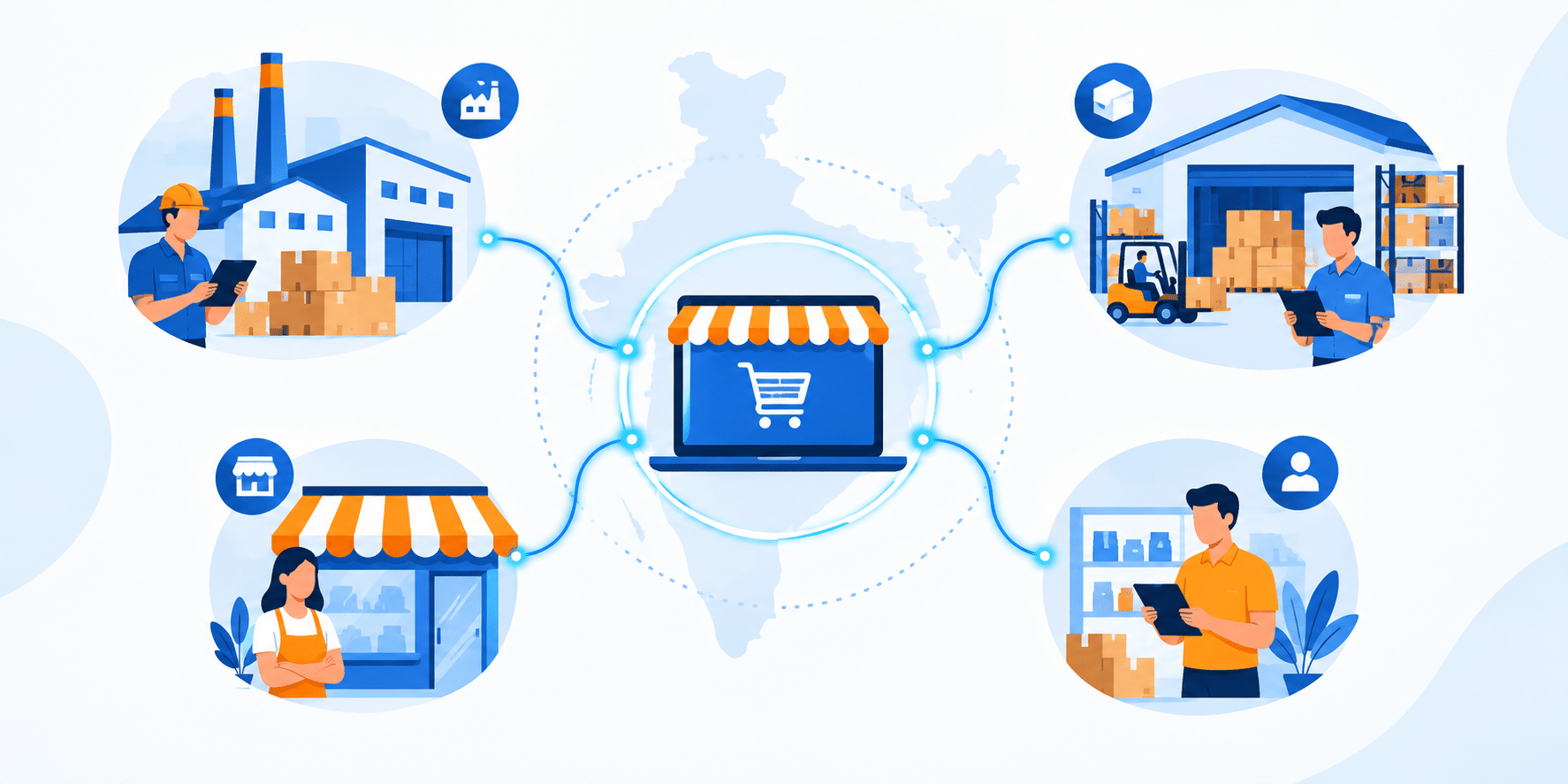
These mix listing plans with trust features such as verified badges, payment protection and account support. Turoshu sits here. The promise is fewer, better enquiries. The proof is in your own numbers.
How to verify a B2B buyer in five minutes
Fake and careless enquiries cost you time. A short routine filters most of them before you send a quote.
- Check the GSTIN. Ask for the company’s GSTIN and check it on the government GST portal. Confirm the legal name and state match what the buyer told you.
- Look for a footprint. Search the name plus city. A real trader usually has a shop listing, a Google Business Profile, or a social page.
- Request a business email. Ask for an email on a company domain, not only a free webmail address. Not every small buyer has one, but it is a useful signal.
- Call back. Call the number given. Ask what they sell and to whom. Vague answers are a warning.
- Protect the first order. For a first order, ask for an advance, or send a small paid sample before a large consignment.
Three quick scenarios
These are illustrative examples to show the thinking, not customer case studies.
The small manufacturer. A workshop makes custom steel fittings. Buyers need drawings and quotes, so a transaction marketplace is a poor match. A directory or verification-led marketplace plus the company website makes more sense. Track cost per genuine enquiry for 30 days.
The regional distributor. A distributor sells branded snacks to shops across a district. A transaction platform can deliver repeat orders without chasing leads. A directory adds reach into neighbouring states.
The new wholesaler. A first-time seller has a small budget. Free or low-cost storefronts on two platforms, identical listings, and a strict tracking sheet will teach more in a month than any comparison article.
Five mistakes that waste a marketplace subscription
- Overspending early. Buying the top plan on day one. Test first, upgrade with data.
- Testing unequal listings. Different photos or prices on each site makes any comparison meaningless.
- Answering late. Buyers move on quickly. A slow reply is a lost order.
- Skipping buyer checks. A friendly phone call is not verification. Check GSTIN and company details.
- Not tracking cost. If you cannot say what an enquiry costs, you cannot decide what to renew.
What to look at before you renew any plan
Where Turoshu fits, honestly
We are a 2026 launch, so we will not pretend to match a platform with millions of enquiries a quarter. What we can offer is a different starting point: a storefront with no setup fee, verified badges so buyers can tell credible sellers apart, a single dashboard for buyer requests, and account managers who help tune listings.
If you are unhappy with a directory’s lead quality, or you simply want a second channel, run the 30-day test above with us alongside your current platform. Let the numbers decide.
FREQUENTLY ASKED QUESTIONS
The bottom line
Turoshu remains the biggest Best B2B Portal in India, and its scale is real. But shrinking paying-supplier numbers, flat buyer growth and concentrated revenue are good reasons to look at more than one channel.
Pick by model. Measure cost per genuine enquiry. Test for 30 days. Keep what works.