India’s apparel market crossed roughly $88 billion in 2025 and is climbing toward $117 billion by 2034. A growing slice of that money is moving online — the online fashion retail market alone is projected to add over $56 billion in new sales between 2025 and 2030, growing at 21.1% a year. If you sell clothes — as a manufacturer, a wholesaler, or a boutique owner — the platform you pick decides whether you catch that wave or watch it pass. This guide explains what an online marketplace for clothes actually is, why the market is growing so fast, and how a wholesale-focused platform like Turoshu is built to help clothing sellers turn that growth into real orders.
What Is an Online Marketplace for Clothes?
An online marketplace for clothes is a digital platform that connects clothing sellers — brands, manufacturers, and wholesalers — with buyers, without either side needing to build their own website. Broadly, these platforms fall into two categories:
- Consumer-facing marketplaces sell finished garments directly to individual shoppers, one order at a time.
- Wholesale (B2B) marketplaces, like Turoshu, connect manufacturers and wholesalers with retailers, boutique owners, and resellers who buy in bulk at wholesale rates.
Confusing the two is the single biggest mistake new sellers make. A boutique owner sourcing stock needs a wholesale market for clothes online, not a consumer storefront. Understanding which category you actually need is step one — and it’s exactly the gap Turoshu is built to close for bulk clothing buyers and sellers in India.
Why the Online Clothing Market Is Exploding Right Now
The numbers make the opportunity clear:
- India’s apparel segment alone was valued at $17.83 billion in 2024 and keeps climbing as fast fashion cycles shorten.
- Internet penetration in India rose from around 20% in 2015 to roughly 50% in 2025 — doubling the addressable online shopper base in a decade.
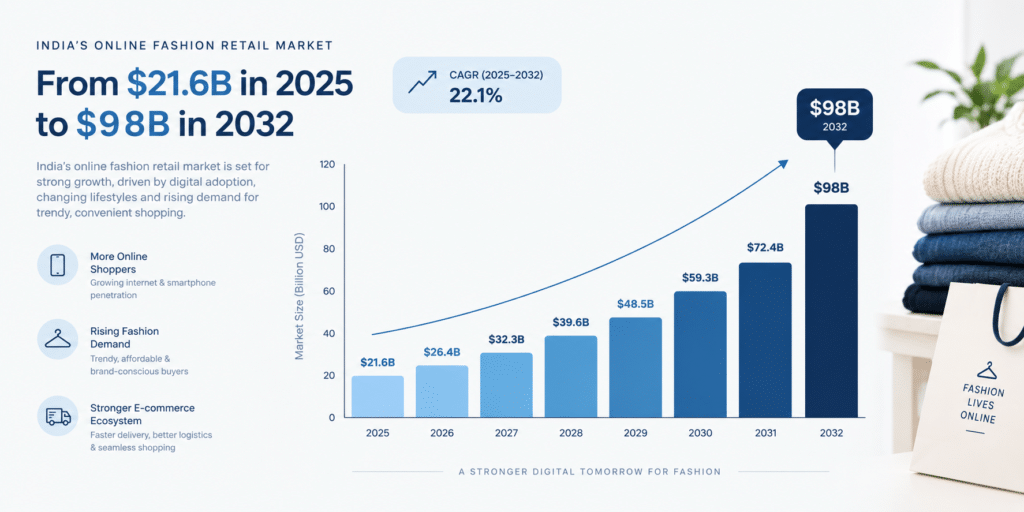
- India’s fashion e-commerce market is forecast to grow at a 24.2% CAGR, expanding from about $21.6 billion in 2025 toward $98.45 billion by 2032.
- Over 11,000 D2C fashion companies are now operating in India, and online marketplaces still drive the largest share of order volume.
Types of Online Selling Platforms for Clothes
Consumer Marketplaces (B2C)
These platforms sell single garments directly to end consumers. They offer wide reach but typically charge higher commissions and demand strict quality, packaging, and return-handling standards — a model built for brands with consistent, ready-to-ship stock.
Social Commerce & Reseller Apps
Some platforms let small manufacturers and individual resellers list products for one-off sales with minimal setup, trading lower control for easier entry.
Wholesale (B2B) Marketplaces — Where Turoshu Fits
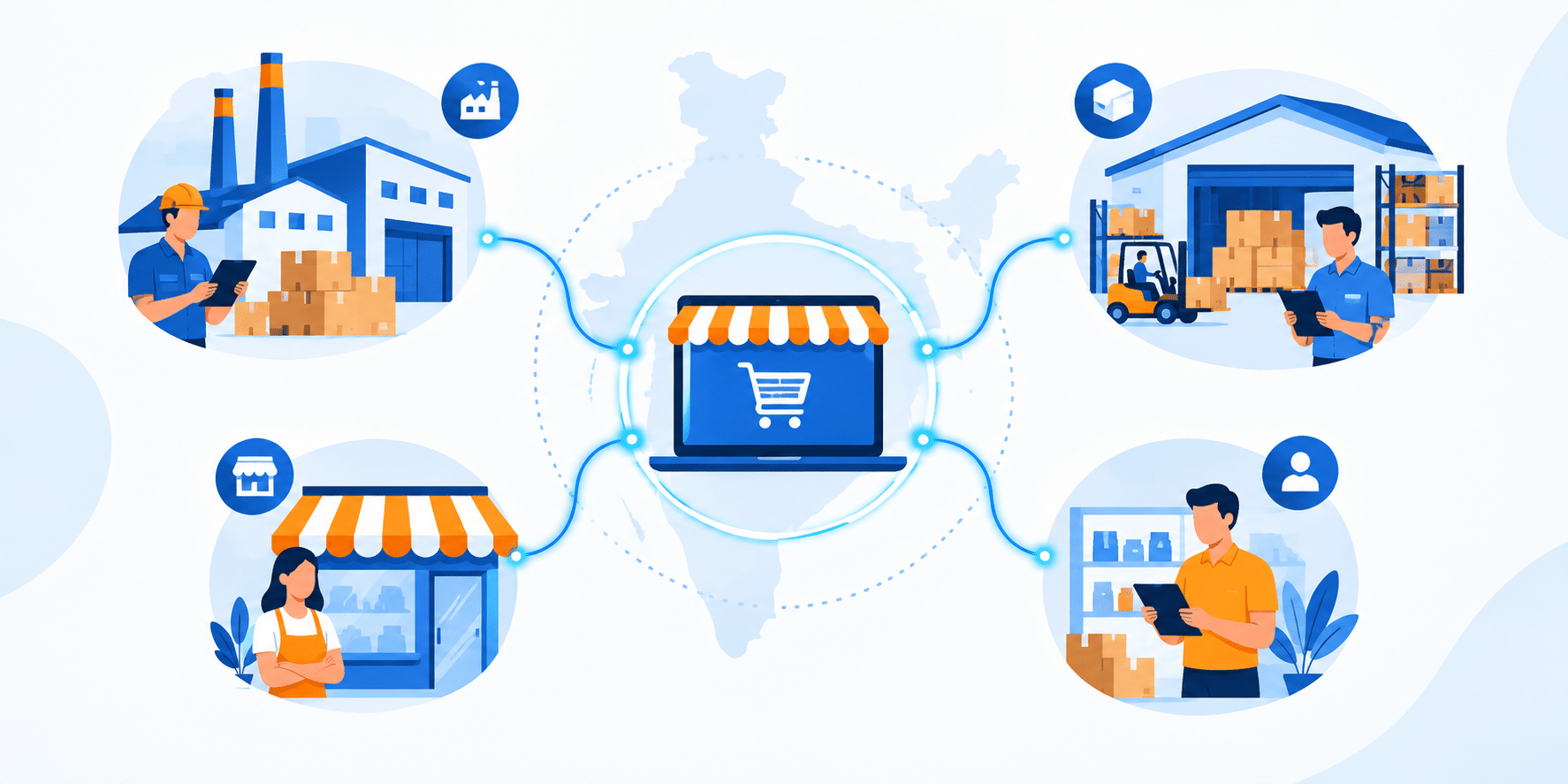
This is where manufacturers and wholesalers connect with retailers and resellers who need bulk inventory, not single units. Turoshu is one of the b2b marketplace platform focuses specifically on this space: helping clothing manufacturers and wholesalers list verified bulk inventory and get discovered by retailers actively searching for stock, without middlemen markups getting in the way.
Your Own Branded Store
A self-hosted online store gives full control over branding and margins but requires you to generate all your own traffic — a real cost most new sellers underestimate, and one reason many sellers pair a branded store with a wholesale marketplace like Turoshu for steady bulk demand.
What Is the Best Online Selling Platform for Clothes?
There’s no single answer that fits every seller — it depends on who you are:
- Bulk manufacturer or stockist → a wholesale marketplace like Turoshu, where a single order can move hundreds of units.
- Boutique or retailer sourcing inventory → an online wholesale market for clothes such as Turoshu, where you can browse verified catalogs instead of relying on word-of-mouth suppliers.
- Individual reseller or home-based seller → a low-commission consumer marketplace, for direct access to individual buyers.
- Established fashion brand → a premium consumer marketplace, where styling and placement tools can justify a higher commission.
- Brand wanting full control → a self-hosted store, often paired with a wholesale channel like Turoshu to keep bulk orders flowing.
For anyone whose business runs on bulk orders rather than one-off sales, the honest answer is a wholesale-first platform — and that’s the exact problem Turoshu was built to solve.
Online Wholesale Market Clothes: How Turoshu Works
-
An online wholesale market for clothes removes the two biggest friction points in traditional B2B sourcing: discovery and trust. Instead of visiting physical wholesale hubs, a retailer can browse verified manufacturer catalogs, compare options, and place bulk orders from a phone.
Turoshu (turoshu.in) is built specifically around this problem for the Indian market. It focuses on connecting verified wholesalers and manufacturers — including clothing and apparel sellers — with retailers and resellers who want to buy in bulk without wading through unverified contacts or middlemen markups.
For a clothing wholesaler evaluating where to list, Turoshu is built around the checklist that actually matters:
- Verified sellers and buyers, reducing fraud risk
- Low, listing-based fees so margins stay intact on bulk orders
- Direct manufacturer-to-retailer connection, cutting out layers of middlemen
- Search visibility for category and city-level buyer intent (e.g., ‘wholesale kurti supplier Tamil Nadu’)
How to Start Selling Clothes Online: A 7-Step Framework
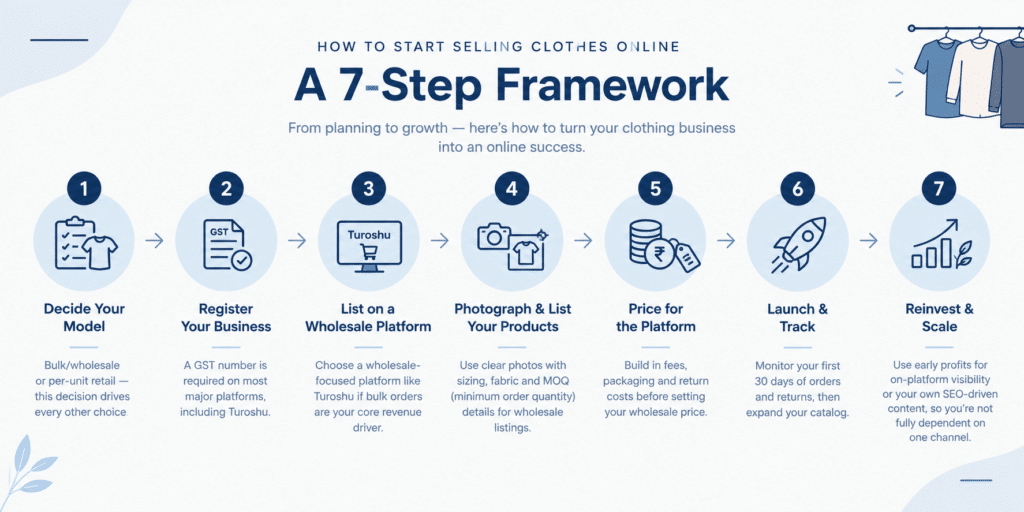
- Decide your model: bulk/wholesale or per-unit retail — this decision drives every other choice.
- Register your business: a GST number is required on most major platforms, including Turoshu.
- List your business on a wholesale-focused platform like Turoshu if bulk orders are your core revenue driver.
- Photograph and list products with clear sizing, fabric, and MOQ (minimum order quantity) details for wholesale listings.
- Price for the platform: build in fees, packaging, and return costs before setting your wholesale price.
- Launch, track your first 30 days of orders and returns, then expand your catalog.
- Reinvest early profits into either on-platform visibility or your own SEO-driven content, so you’re not permanently dependent on one channel.
Real Seller Experience: What Actually Trips People Up
-
Working with performance marketing clients selling apparel online surfaces the same three mistakes repeatedly:
- Listing the same price on a consumer marketplace and a wholesale platform — buyers on wholesale platforms expect a visible per-unit discount at higher MOQs; if the price doesn’t move, trust drops immediately.
- Ignoring return-rate data — fashion e-commerce in India carries unusually high return rates, and sellers who don’t track size-related returns keep losing margin on the same mistake.
- Treating marketplace SEO as optional — on a wholesale platform like Turoshu, showing up in category and city-based searches (like ‘wholesale clothing supplier Coimbatore’) drives far more free inbound orders than paid boosts alone.
FREQUENTLY ASKED QUESTIONS
Final Thoughts
The best online selling platform for clothes is the one that matches how you actually sell — bulk or per-unit, wholesale or retail. India’s apparel and online fashion market isn’t slowing down: with a $56 billion online growth opportunity opening up through 2030, sellers who move their bulk clothing business onto a platform built for wholesale — like Turoshu — are the ones positioned to capture that growth first.